Rhodes
Medieval old town, organised beaches and nightlife — something for everyone.
Highlights
Beaches
Sights
Suggested 5-day itinerary
Where to stay in Rhodes
Rhodes is around eighty kilometres end to end, which makes it one of the few Greek islands where the wrong base genuinely costs you days. Decide first whether you want the medieval town, a beach resort, or Lindos.
- The Old Town — the largest inhabited medieval town in Europe, walled, cobbled and closed to cars. Extraordinary to sleep inside, and worth doing once. Be aware the stone holds heat well into the night in August, and the lanes around the taverna streets are loud.
- The New Town — modern Rhodes just outside the walls, with Elli beach, the restaurants locals actually use, and easy transport to the airport and the port. Less atmospheric, far more practical.
- Lindos — whitewashed houses stacked under an acropolis, and the most beautiful village on the island. Also the most expensive, and overrun by coach and cruise groups between roughly ten and four. Best if you stay the night and have it to yourself at either end of the day.
- Pefkos, Lardos and Kiotari — the southeast coast just past Lindos, quieter and better value, with sandy beaches and a car making everything easy.
- Faliraki — the big package resort with a long sandy beach and a waterpark. Its party reputation is older than its current reality, but the northern end is still where the nightlife is.
- Ixia and Ialysos — the west coast strip, big hotels and reliable wind. People come here specifically to windsurf.
- The far south, Gennadi and Prasonisi — genuinely quiet, close to empty in shoulder season, and the base for kitesurfing.
The beaches, and the rule that decides your day
One thing matters more than any beach list: the west coast takes the meltemi head-on and the east coast is sheltered. If it is blowing, drive east.
- Tsambika — a long sandy bay on the east coast, organised, and the best all-round beach on the island. The monastery on the hill above it is a stiff climb with a view worth it.
- Anthony Quinn Bay — small, rocky and startlingly clear, named after the actor who fell for it while filming The Guns of Navarone. Tiny, so arrive early.
- Ladiko — next door and slightly easier, sandy in patches.
- Agathi, Golden Beach — soft sand near Haraki, shallow and good with children.
- St Paul's Bay — a near-enclosed cove under the Lindos acropolis, calm and photogenic. Two small beaches, both busy in season.
- Prasonisi — the southern tip, where the Aegean meets the Mediterranean on either side of a sandbar. One side flat, one side windy. A kitesurfing destination in its own right, and the sandbar is submerged when the water is high in spring.
- Elli — the town beach in the New Town, pebbly and convenient rather than beautiful.
- Ixia — west coast, windy by design, and the windsurfing base.
The Old Town and the sights
- The Palace of the Grand Master — rebuilt in the twentieth century on the Knights' foundations, with Roman mosaics brought in from Kos. Cool inside, which matters in July.
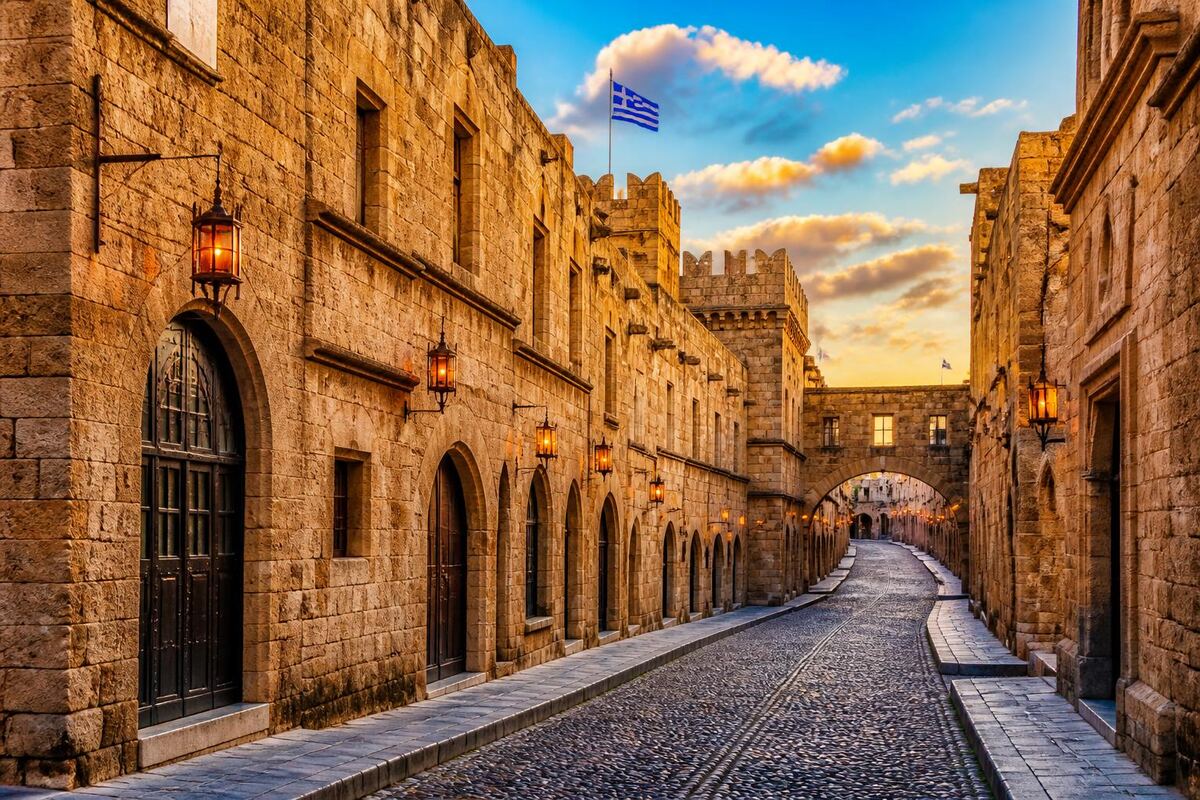
- The Street of the Knights — a straight medieval street of inns, one for each language group of the Order. Best early in the morning when it is empty.
- The Archaeological Museum — housed in the Knights' Hospital, and worth it for the building as much as the collection.
- The walls and the moat — you can walk the dry moat around a long stretch of the fortifications, mostly in shade and almost always quiet.
- Lindos Acropolis — the Temple of Athena Lindia on the rock above the village, with the view that explains why it is there. A steep climb; go early or late. Donkeys are offered for the ascent, but walking is straightforward for most people and avoids the question entirely.
- Ancient Kamiros — a Doric city abandoned and buried, then excavated. Laid out clearly enough that you can read the streets, and far quieter than Lindos.
- The Valley of the Butterflies — Jersey tiger moths gathering in a shaded ravine, roughly June to September. Outside those months it is a pleasant walk and nothing more.
- Filerimos and Monolithos — a hilltop monastery with a long avenue of cypresses, and a castle perched on a rock on the west coast.
One honest note: the Colossus of Rhodes, one of the Seven Wonders, has left nothing behind. Nobody even agrees where it stood. Do not build a day around it.
Getting there and how long to stay
- Flights — Rhodes has direct international flights through the season and year-round domestic, which is how most visitors arrive. It is one of the easiest Greek islands to reach without going through Athens.
- Ferry from Piraeus — a long crossing, generally overnight on a conventional ferry. Most people fly.
- The Dodecanese — Symi is an easy day trip, and Kos, Halki and Tilos all connect. Marmaris in Turkey is a short catamaran ride.
- Getting around — hire a car. The island is too long for buses to be practical if you want to see more than your own resort, and the best beaches and sites are spread from top to bottom.
- Three days covers the Old Town, Lindos and one beach. Five adds Kamiros, the west coast castles and the south. A week is comfortable here in a way it is not on smaller islands.
Useful tips
- The Old Town is best early morning or late afternoon
- Rent a car for the southern villages
Pairs well with
Where it is
Frequently asked questions
Where should I stay in Rhodes?
Do you need a car in Rhodes?
Which are the best beaches in Rhodes?
Is Lindos worth visiting?
When is the best time to visit Rhodes?
Can you see the Colossus of Rhodes?
Plan your trip to Rhodes
Find the best prices for stays, activities and ferries.
Some links are affiliate links: we may earn a commission on a booking, at no extra cost to you.
Featured in Rhodes
Selected stays, restaurants and activities.
Have a business in Rhodes? Feature it here to travellers who are coming.
List your business →Last updated: 23 July 2026 · Spot something out of date? hello@greecedays.com